

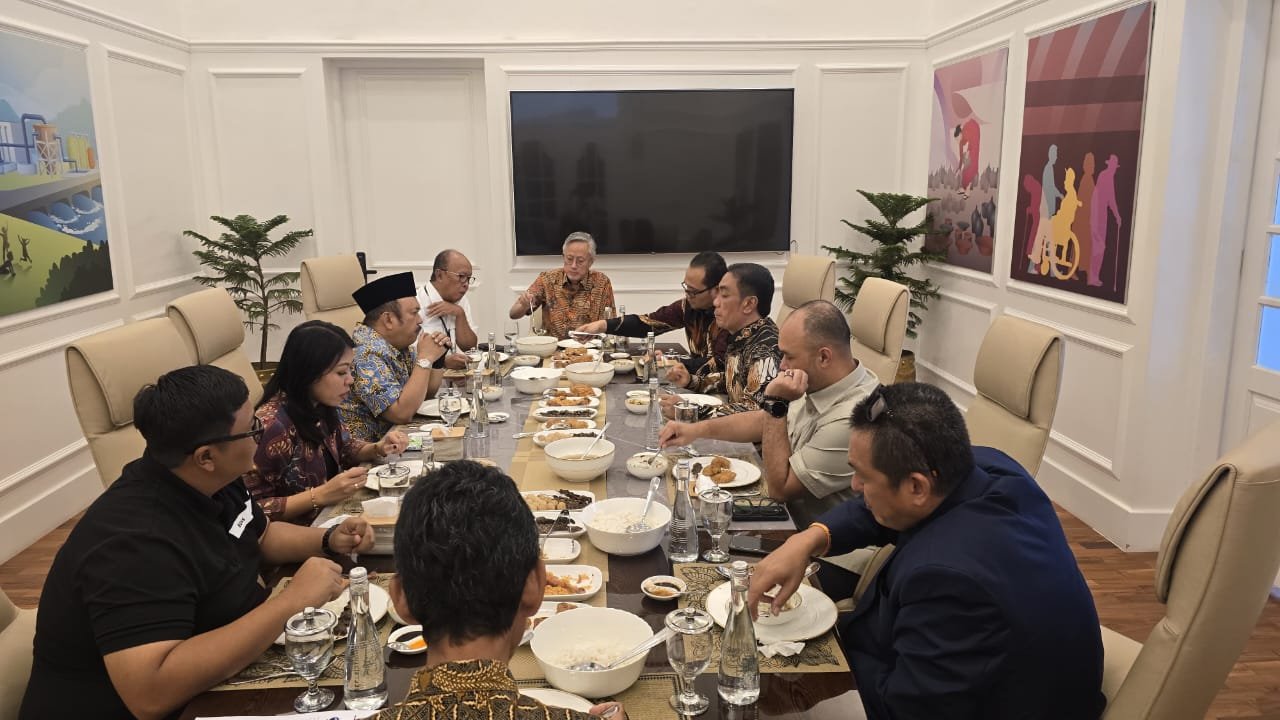
JAKARTA, JAKTIMES.COM— The Ministry of National Development Planning/National Development Planning Agency (Bappenas) has called on the Indonesian Agricultural University (IPB) Alumni Association to play a more active role in strengthening the upstream food supply for the Free Nutritious Meal Program (Makan Bergizi Gratis/MBG).
The message was conveyed by Minister of National Development Planning/Head of Bappenas Rachmat Pambudy during a meeting with the newly elected Chairman and Secretary General of the IPB Alumni Association (HA IPB), Fauzi Amro and Anggawira, at the Bappenas office in Taman Surapati, Central Jakarta.
Rachmat emphasized that the success of the MBG program depends heavily on a strong, integrated, and sustainable agricultural supply chain. The program requires a stable supply of quality food ingredients that can be delivered on time, from the production stage through early processing.
“MBG should not be viewed merely as a consumption program. The key lies upstream—how national food production can consistently support demand,” Rachmat said.
Bappenas encouraged IPB and its alumni network to consolidate professionals across the food ecosystem, including farmers, livestock breeders, fishermen, nutritionists, food technologists, and logistics players. This consolidation aims to strengthen the MBG’s backward industry, ensuring food supplies are sourced from domestic production and developed on a regional basis.
According to Rachmat, the MBG program requires scheduled production patterns and uniform quality standards. Partnership schemes and production contracts are considered essential to maintaining supply continuity and providing price certainty for producers at the upstream level.
Newly elected HA IPB Chairman Fauzi Amro expressed the readiness of IPB alumni to serve as a cross-professional coordination hub. This role is intended to integrate production, post-harvest handling, and distribution processes in line with the needs of MBG kitchens across regions.
“IPB alumni can act as a bridge between producers on the ground and the operational needs of the MBG program, ensuring the right quantity, quality, and timely delivery of food supplies,” Fauzi said.
Meanwhile, newly elected HA IPB Secretary General Anggawira highlighted that strengthening the upstream food sector for MBG is not only about supply security but also about boosting rural economic growth. With the right approach, the program is expected to increase incomes for farmers and local food businesses.
“If the upstream sector is strengthened, local economies will move forward. Farmers and village-based enterprises gain market certainty, while the country secures a resilient national food supply,” Anggawira said.
Bappenas also underlined the importance of involving universities and their alumni networks in developing technical standards, providing field assistance, and utilizing production data. Such support is seen as key to accelerating the integration of the MBG program with national and regional development planning.
The meeting reaffirmed the direction of MBG as a nutrition program underpinned by a robust national food production system.
Strengthening the agricultural upstream sector is viewed as critical to ensuring the program runs consistently and efficiently, while delivering measurable economic benefits to the community (Wan)