

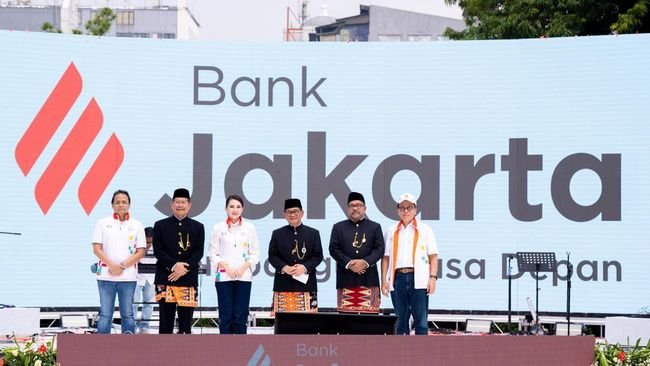
JAKARTA, JAKTIMES.COM– Under Jakarta’s restless skyline—where the city never truly sleeps—one name is steadily reshaping its identity: Bank Jakarta.
More than a simple rebranding from its former identity as Bank DKI, it represents a gradual but determined effort to step out of the shadow of the past and into a more competitive, transparent, and digitally driven banking era.
Amid this ongoing transformation, a legal development once again drew attention: the acquittal of several former regional bank executives in the credit case involving PT Sritex. Yet inside the institution’s current command structure, the noise of courtroom headlines does not alter its course.
The transformation engine continues to run.
Between Old Cases and New Ambitions
The Sritex credit case—centered on one of Indonesia’s major textile corporations—has long become part of the broader discussion on banking governance and credit discipline.
In the Tipikor Court in Semarang, the acquittal of four former regional bank executives closed one chapter of the legal process, but it did not end the wider debate on prudence, authority, and accountability in banking decisions.
It is within this context that Bank Jakarta chooses to position itself—not in the courtroom, but in a quieter arena: institutional reform.
“Business transformation and governance strengthening will continue,” the bank emphasized in its official statement. A formal sentence on the surface, yet in the banking world, it functions as a compass—defining whether an institution remains anchored in legacy systems or evolves into a modern financial entity capable of anticipating risk before it materializes.
Governance: The Invisible Architecture of Trust
Behind glass towers and digital dashboards, governance is the invisible architecture that holds everything together.
It does not sell products or attract customers directly, but it determines whether trust exists at all.
In the banking industry, a single misstep in credit decision-making can ripple into systemic pressure.
That is why governance is often described as the backbone of financial institutions—silent, structural, and absolutely essential.
Today, Bank Jakarta is in the process of rebuilding that backbone. Strengthening risk management, enforcing compliance discipline, and accelerating digital transformation in credit systems are part of its evolving institutional landscape.
Learning from Industry, Learning from Experience
The PT Sritex case has become a mirror for Indonesia’s banking sector. It is not merely about legal outcomes, but about how business decisions are made, supervised, and justified within complex financial ecosystems.
In modern banking, the line between aggressive expansion and systemic risk is often razor-thin.
Large corporate lending—especially in capital-intensive industries like manufacturing—always carries dual consequences: growth potential on one side, and balance sheet vulnerability on the other.
This is where transformation becomes critical. Banks that fail to adapt risk stagnation. Those that transform without discipline risk instability. The challenge lies in maintaining equilibrium.
Jakarta and Its Bank: Two Identities Moving in Parallel
The transformation of Bank Jakarta cannot be separated from the evolution of the city itself. Jakarta is undergoing its own transition—from a national administrative capital into a more complex, globally integrated economic hub.
In such a landscape, regional banks can no longer function merely as local government cash managers.
They must become competitive financial players—capable of reading markets, embracing financial technology, and serving a new generation of customers who rarely visit branches and instead live within digital ecosystems.
Closing One Chapter, Opening Another
In boardrooms, transformation rarely looks dramatic. There are no headlines, no cinematic breakthroughs. Instead, there are audits, policy revisions, risk frameworks, and long internal discussions that rarely reach public attention.
Yet it is precisely within these quiet processes that the future of a bank is shaped.
Legal cases may unfold in courtrooms. Public debate may continue outside. But internally, Bank Jakarta appears to have chosen its direction: rebuilding trust, strengthening governance, and advancing toward a redefined identity.
In a city as vast and dynamic as Jakarta, change is rarely loud. More often, it moves like an undercurrent—slow, consistent, and ultimately powerful enough to reshape the shoreline itself (Wan)