

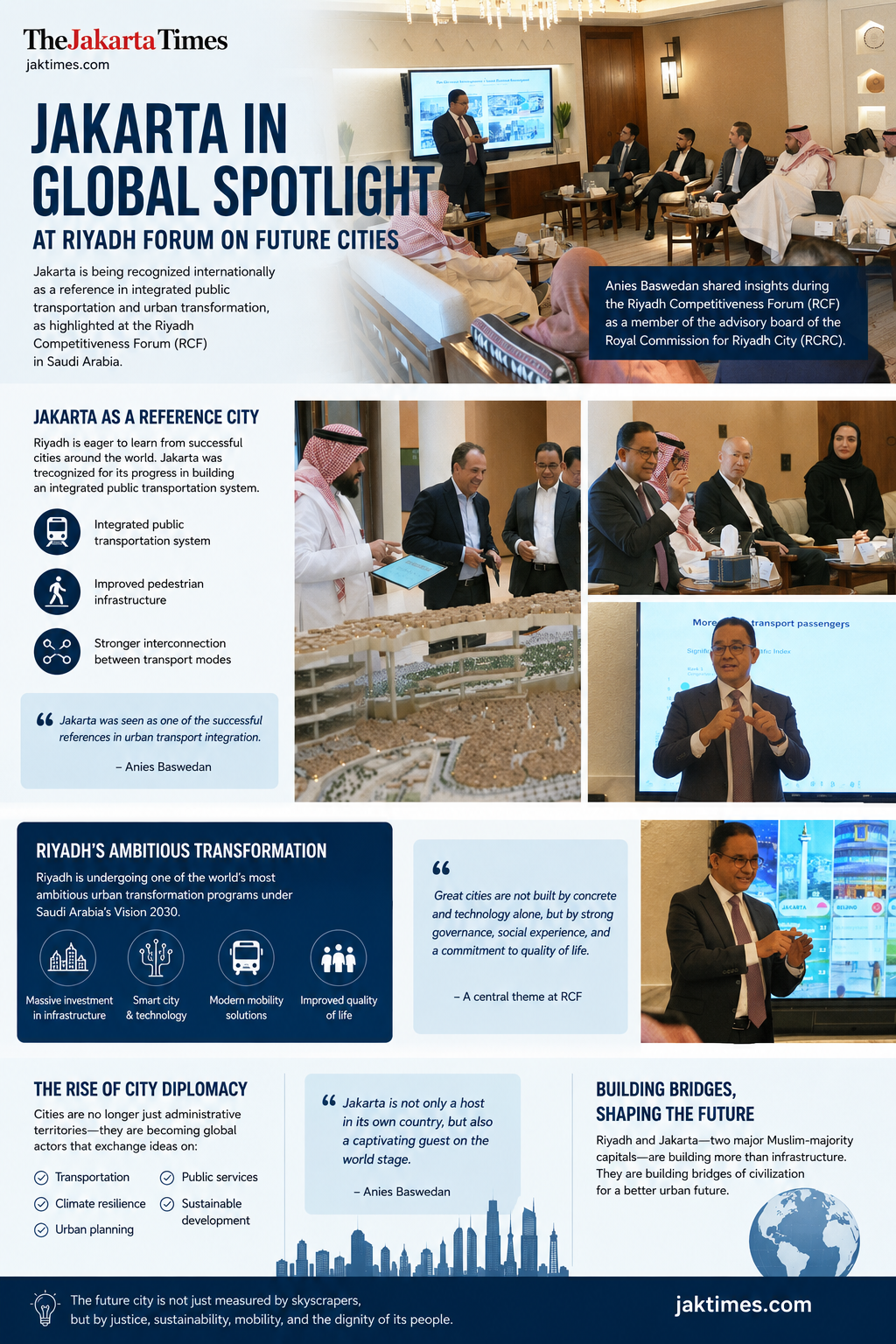
RIYADH, JAKTIMES.COM — Jakarta has emerged as an unexpected point of reference in global discussions on urban transformation, with the Indonesian capital highlighted during the Riyadh Competitiveness Forum (RCF) as an example of integrated public transportation development and city modernization.
The acknowledgment was shared by Anies Baswedan following his participation in the forum held in Riyadh, where international urban planners, policymakers, and strategic advisers gathered to discuss the future of cities in an era shaped by rapid urbanization, climate pressures, and technological change.
Baswedan attended the event not only as a speaker and observer, but also in his capacity as a member of the advisory board for the Royal Commission for Riyadh City (RCRC), the institution overseeing Riyadh’s long-term urban transformation agenda.
In a public statement posted after the event, Baswedan said Riyadh authorities were eager to learn from cities around the world, including Jakarta, which he described as having made significant progress in developing an integrated public transportation system.
“Jakarta was seen as one of the successful references in urban transport integration,” he wrote, emphasizing the growing recognition of Indonesia’s capital in international urban policy discussions.
For decades, Jakarta has been associated with chronic traffic congestion, pollution, flooding, and the immense pressures of rapid population growth.
Yet over the last ten years, the city has undergone visible changes through the expansion of mass transit systems, improved pedestrian infrastructure, and stronger interconnection between transportation modes.
Those developments, once viewed as incremental local reforms, are now increasingly being observed by cities seeking models for sustainable urban growth.
Riyadh itself is currently undergoing one of the world’s most ambitious urban transformation programs under Saudi Arabia’s Vision 2030 initiative.
The kingdom is investing heavily in infrastructure, mobility, smart-city technology, tourism, and public space development as part of broader efforts to diversify its economy beyond oil dependence.
But beyond futuristic architecture and megaprojects, discussions at the forum reflected a growing awareness that successful cities are shaped not only by physical infrastructure, but also by governance, inclusivity, and quality of life.
That is where Jakarta’s experience has become increasingly relevant.
The forum also underscored the rise of what urban experts describe as “city diplomacy” — a growing phenomenon in which cities engage directly with one another to exchange ideas on transportation, climate resilience, housing, public services, and sustainable development.
In this evolving global landscape, cities are no longer merely administrative territories. They are becoming international actors capable of influencing policy conversations across borders.
For Jakarta, the recognition marks a notable shift in perception. Long viewed internationally as a city struggling with the burdens of over-urbanization, the Indonesian capital is gradually positioning itself as a case study in metropolitan adaptation and transformation.
Baswedan described the moment as part of Jakarta’s journey toward becoming a “global city” — one capable not only of hosting the world, but also contributing ideas to it.
The significance of the exchange also resonates across the broader Muslim world. Riyadh and Jakarta, two major Muslim-majority capitals shaped by distinct histories and cultural landscapes, are increasingly connected through conversations about the future of urban civilization.
As climate change, population growth, and declining urban livability become global concerns, policymakers are confronting deeper questions about what defines a successful modern city.
Should future cities be measured only by skyscrapers and technological sophistication? Or should they also be judged by social equity, environmental sustainability, accessible public transportation, and the dignity they provide to residents?
Those questions are now being discussed across borders — and from Riyadh, Jakarta has become part of that global conversation (Marwan Aziz)