

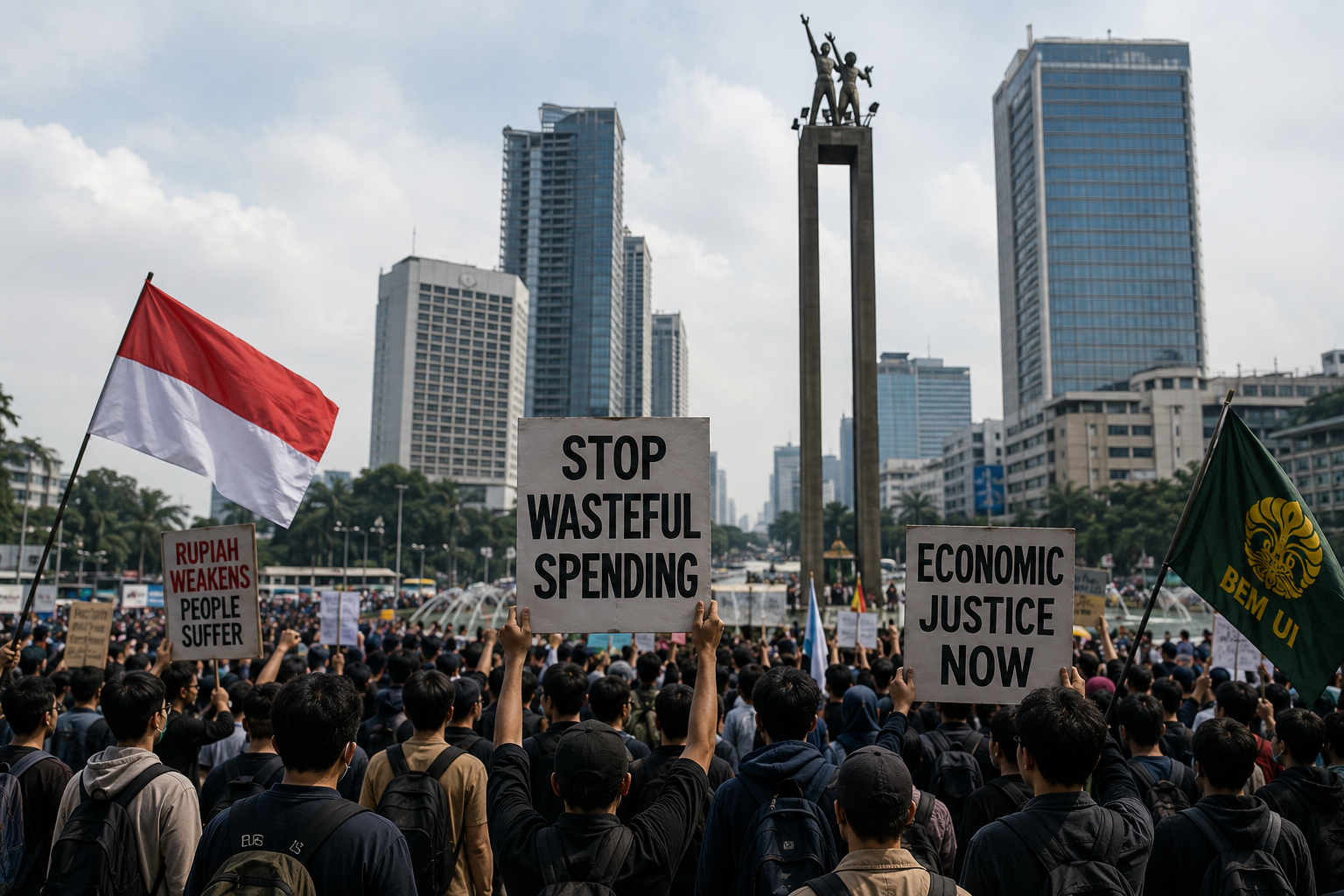
Hundreds of students and civil society activists gather at Jakarta’s Hotel Indonesia (HI) Roundabout ahead of a planned “Reformasi II” demonstration, calling for fiscal reforms, lower living costs, and greater government accountability amid the weakening rupiah. Illustration: Jaktimes.com/AI Generated.
JAKARTA, JAKTIMES.COM – The weakening of the Indonesian rupiah against the U.S. dollar has sparked a nationwide consolidation movement involving university students and civil society groups. Participants argue that the rupiah’s decline is not merely a currency exchange issue but a reflection of deeper problems in economic governance and government policymaking.
During a consolidation forum held at the University of Indonesia in Depok on Wednesday (June 10, 2026), participants agreed on five key demands to be brought forward during a mass demonstration scheduled at Jakarta’s Hotel Indonesia (HI) Roundabout on Friday (June 12, 2026).
The rally is expected to become one of the largest student- and civil society-led demonstrations in recent months, focusing on economic issues that many believe are increasingly burdening ordinary Indonesians.
Five Demands to the Government
The forum produced five major demands:
- Stop wasteful state budget spending (APBN).
- Lower the prices of basic necessities and fuel.
- Terminate the Free Nutritious Meals Program (MBG).
- Halt the development of the Red-and-White Village Cooperative Program.
- End militarism in civilian affairs and urge President Prabowo Subianto to acknowledge government mistakes in handling national issues.
For participants, the weakening rupiah is only a visible symptom of a much broader problem. They argue that deeper concerns lie in the direction of economic policy, the effectiveness of state spending, and national development priorities.
HI Roundabout Chosen as a Symbol of Resistance
Hafidz Haernanda, Coordinator for Social and Political Affairs, explained that the HI Roundabout was chosen for strategic and symbolic reasons.
“Perhaps HI Roundabout appears extravagant and luxurious. But if we protest in front of Parliament, will we really be heard? Whether many or few people join, this demonstration is a statement that Indonesia is tired,” he said.
According to Hafidz, the planned protest reflects growing public frustration over the economic pressures increasingly felt in everyday life.
He emphasized that the demonstration is not simply an expression of anger but an effort to push the government to provide concrete solutions to the nation’s challenges.
Students Question Fiscal Credibility
Meanwhile, Jundi Al Muhandis, Chairman of the Student Executive Board (BEM) of the Faculty of Economics and Business at the University of Indonesia, argued that the rupiah’s depreciation cannot be separated from concerns over the government’s fiscal credibility.
According to him, the most urgent step is to stop wasteful state spending and redirect public funds toward productive sectors.
“We can demand fiscal credibility by stopping wasteful state budget spending. We still do not know how stable the rupiah will be in the future, but reducing unnecessary spending can generate long-term benefits by directing funds toward productive sectors,” Jundi said.
He also criticized the Red-and-White Village/Subdistrict Cooperative Program (KDMP), arguing that it could create a crowding-out effect, where increased government spending limits investment opportunities and private economic activity.
According to Jundi, the program risks displacing small businesses that have long survived independently.
“The rupiah is in this condition because of fiscal credibility issues and the Red-and-White Village Cooperative program. Therefore, it would be better to focus on stopping wasteful spending. If we only seek short-term rupiah stability, any strengthening will not last long,” he added.
President Becomes Main Target of Demands
The consolidation forum featured lively discussions and differing views regarding the most effective political strategy.
Representatives from SERUNI Women’s Union and several University of Indonesia student organizations argued that demands should be directed straight to President Prabowo Subianto as the country’s highest executive authority.
They contend that many strategic national programs, including the MBG initiative, stem directly from presidential decisions, making the president the primary focus of public pressure.
However, other participants, including students from the Faculty of Law at Pancasila University and UIN, proposed a different approach.
They argued that parliamentary mechanisms remain a viable avenue for change through constitutional means, including the possible use of the House of Representatives’ inquiry rights to scrutinize government policies deemed problematic.
Despite differences in strategy, all participants agreed that Friday’s demonstration at HI Roundabout would serve as a platform to voice public concerns over the country’s economic condition.
For them, the weakening rupiah is merely an early warning sign of a larger crisis. Amid mounting economic pressure, students and civil society groups are preparing to bring a unified message to the heart of the capital: the government must listen to the people before public dissatisfaction grows into a much larger wave of unrest (Wan).