

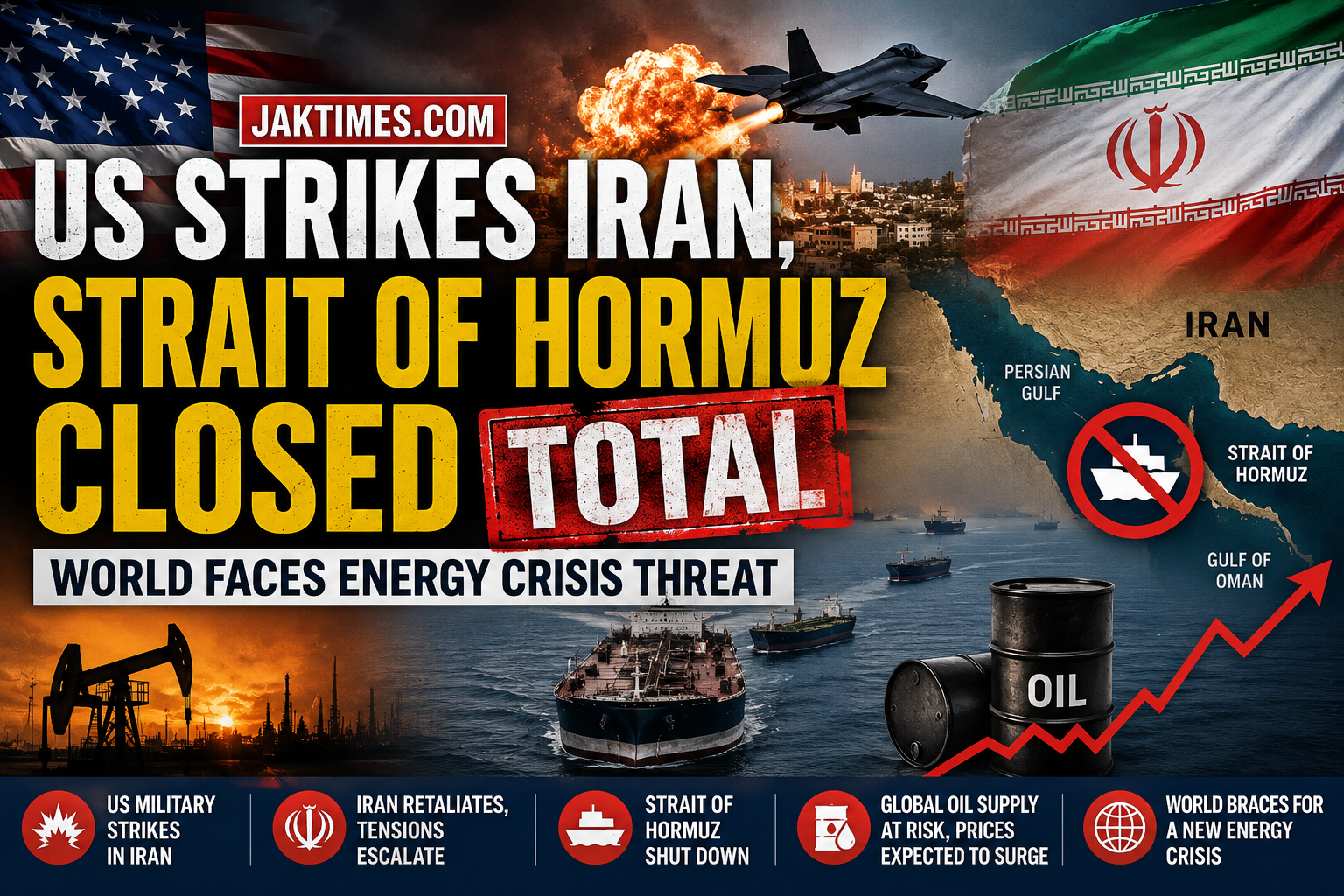
Illustration of escalating tensions between the United States and Iran following reported military strikes and Tehran’s decision to close the Strait of Hormuz, a critical global oil shipping route. The move has raised concerns over potential disruptions to energy supplies and rising oil prices worldwide. Photo illustration: Jaktimes.com.
TEHRAN, JAKTIMES.COM – Tensions between Iran and the United States have once again reached a critical point. Following US military strikes on several targets inside Iran, Tehran has taken the dramatic step of closing the Strait of Hormuz, one of the world’s most vital energy shipping routes.
The decision was announced by Iran’s Persian Gulf Strait Authority (PGSA) through its official account on X on Thursday (June 11). The closure applies to all maritime traffic and will remain in effect until further notice.
“Due to tensions caused by the aggressive actions of US forces and the latest announcement by the Armed Forces of the Islamic Republic, the Strait of Hormuz will be completely closed,” the PGSA said, as quoted by Jaktimes.com from Sputnik.
The authority also urged all shipping operators and vessels that had already received transit permits to remain patient and await further instructions before entering the area.
Iran’s move immediately drew global attention. The Strait of Hormuz serves as a strategic maritime corridor linking the Persian Gulf to the Arabian Sea and is the primary route for oil exports from major Middle Eastern energy producers.
An estimated one-fifth of the world’s oil trade passes through the narrow waterway each day, making any disruption a potentially significant shock to global energy markets.
The closure came just one day after US President Donald Trump accused Tehran of deliberately delaying ongoing negotiations. Trump also signaled Washington’s readiness to launch a major military operation against Iran.
The situation escalated further when the United States Central Command (CENTCOM) confirmed strikes against several targets in Iran. Tehran responded by launching retaliatory attacks against US military bases across the Middle East.
The latest confrontation is the continuation of a conflict that erupted on February 28, when the United States and Israel carried out strikes against several strategic targets in Iran, including locations in the capital, Tehran. The attacks reportedly caused infrastructure damage and civilian casualties.
In response, Iran launched attacks against Israeli territory and US military facilities throughout the region.
Although both sides agreed to a ceasefire on April 7, diplomatic efforts that continued through negotiations in Islamabad failed to produce any meaningful breakthrough. The deadlock has reignited tensions and heightened concerns over the possibility of broader regional instability.
Analysts warn that the closure of the Strait of Hormuz could pose a serious threat to the global economy. If prolonged, the disruption could affect international energy supplies, trigger a sharp increase in crude oil prices, and add inflationary pressure to economies worldwide.
As the risk of a wider confrontation between Washington and Tehran continues to grow, global attention is now focused on the Strait of Hormuz—a narrow waterway whose status could significantly influence energy security and economic stability across the world in the weeks ahead (Wan).