

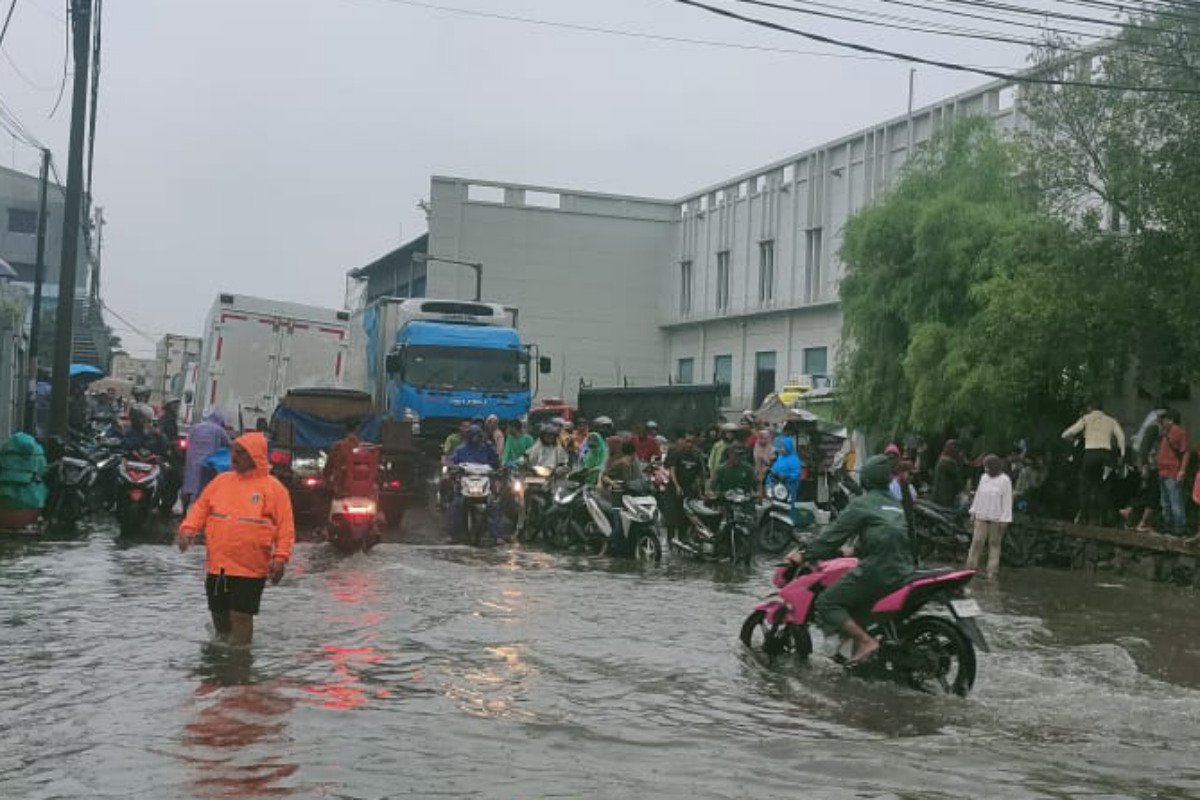
JAKARTA, JAKTIMES.COM– On a scorching Thursday afternoon in Muara Baru, Penjaringan, the sound of seawater slamming against the concrete barrier felt heavier than usual—almost as if it carried a message from the future.
Minutes before the Pelindo sea wall cracked and saltwater burst through, residents had sensed something was off: a sharp wind from the bay, a slowly rising tide, a coastline holding its breath.
When the leak appeared, it wasn’t just a concrete wall that gave way. Jakarta’s frontline defense against climate change once again revealed just how fragile the city remains.
A Coastline That Keeps Sinking
Jakarta is a city built on land that is steadily sinking. Recent data from the Geospatial Information Agency (BIG) and international university research show that parts of North Jakarta are experiencing land subsidence of up to 7–11 centimeters per year—among the fastest in the world.
Combined with rising global sea levels, any concrete barrier, no matter how tall, is gradually losing its advantage.
On the day the leak occurred, the sea level reached 211 centimeters, pressing against the wall until water finally burst through the weakest point.
Heria Suwandi, Head of the North Jakarta Water Resources Sub-agency, immediately deployed 20 members of the “blue troops” to conduct emergency repairs. Hundreds of sandbags were stacked layer by layer, forming a temporary shield between residents’ homes and the relentless seawater.
“This is a rapid response. It’s temporary, but crucial to control the pressure,” he said.
Trapped in a Repeating Cycle
The broken sea wall in Muara Baru is not an isolated incident. It is part of a recurring pattern that returns every time:
- a new moon raises tidal levels,
- monsoon winds push water toward the shore,
- sea walls absorb excessive pressure,
- then crack—or fail.
Coastal residents of Jakarta have lived with this cycle for generations. For many families, tidal flooding is not a sudden disaster; it is a seasonal rhythm, as familiar as harvest time or local celebrations.
But this leak in Muara Baru again raises a bigger question: how much longer can Jakarta hold on?
A Mega Project Racing Against Time
The central government is now pushing the construction of a giant sea wall—a massive 700-kilometer coastal barrier stretching from Banten to East Java. This multi-decade project is envisioned as a long-term shield for the northern coast, including Jakarta.
But the real question is not whether the project can be built, but whether it can be built fast enough.
Studies by Deltares, a Dutch research institute long involved in Jakarta’s coastal planning, warn that without massive intervention, parts of Jakarta’s coastline could become permanently submerged within decades—not because the sea is rising too fast, but because the land is sinking far faster than expected.
The Physical Limits of a City
As sandbags were stacked along the breached sea wall in Muara Baru, it wasn’t just fishermen’s homes or logistics warehouses being protected.
What was at stake was Jakarta’s future—an international megacity forced to confront its physical limits.
Jakarta is not only battling the sea; it is battling gravity, rapid land subsidence, excessive groundwater extraction, and the uncertainty of global climate change.
Amid the noise of the metropolis, the small sound of a cracking sea wall is a reminder that disasters don’t always arrive with a roar. Sometimes they begin with a drop of saltwater finding a gap.
From Muara Baru to the Future
As structural repairs await implementation, coastal residents are urged to stay alert. For them, such warnings are nothing new. But this leak reflects something deeper: Jakarta is in a race against its own time.
If massive coastal barriers are the answer, they must be built faster than the sea is rising—and stronger than the land is sinking.
Muara Baru may be just a tiny point on the map. But the day seawater broke through its wall was a stark warning for the entire capital: Jakarta’s future is already dripping through the cracks of its concrete defenses (Wan)